home
>
SF
>
cons
> Concourse: Eastercon 2004
Concourse: Eastercon 2004
![[Programme Book]](e2004.jpg "[Programme Book]")
The 55th British Easter Science Fiction Convention
9--12 April 2004, Winter Gardens, Blackpool
![[Danny Flyyn]](pic/3258.jpg "[Danny Flyyn]")
GoHs: Mitchell Burnside Clapp, Danny Flynn, Sue Mason,
Christopher Priest
,
Philip Pullman
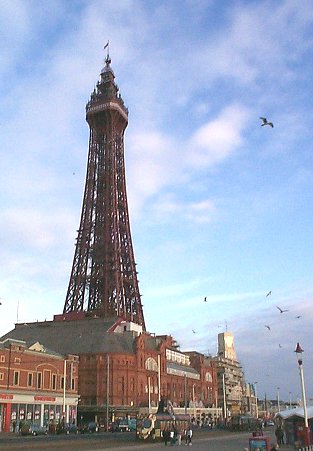
Our first time back to Blackpool since
1992
. We
were reacquainted with the land of
towers
and
piers
, where even the
trams
get SFnal
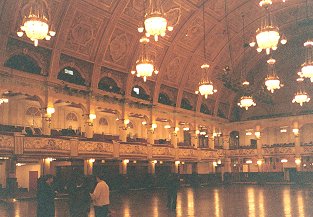
. The con wasn't at the Norbreck this time, but at the
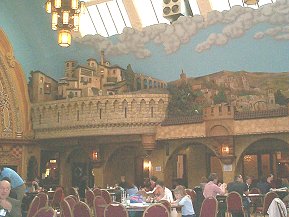
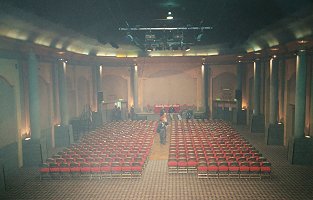
truly astonishing Winter Gardens, with whose
enormous
rooms
and
unique decor
even a willing
suspension of disbelief struggles occasionally.
Programme highlights
![[in the Ballroom]](pic/3237.jpg "[in the Ballroom]")
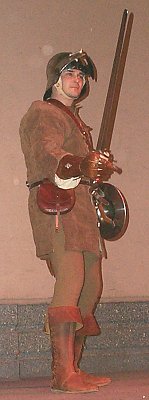
Academie Glorianna --
Weapons display
-
In high stress situations, we use ~ 25% of our intelligence -- we
need "cues" and trained reflexes to help
-
The first fight in the film The Duelists has probably the most
accurate swordplay in a film -- they are trying to gauge each other's
skill level
-
the sword is the only early weapon not derived from a hunting,
agriculture or manufacturing tool
-
The fuller -- the groove in the blade -- is not to let the blood run
out, it is purely to make the sword lighter
-
the pommel is the counter-weight to the weight of the blade
-
kinetic energy
E
=
mv
2
/2, force
F
=
ma
-
so velocity counts for more than mass -- if exert a constant
force, get most energy from a high acceleration (high end velocity),
which means minimum mass
-
Use the Whole Weapon -- hit them with the pommel, etc
-
Sacrifice -- discard the weapon (and use another one!) if necessary
![[Sue Mason, Fran Dowd]](pic/3238.jpg "[Sue Mason, Fran Dowd]")
Sue Mason --
GoH interview
-
Medieval banquet last night
-
teaching our wench how to trollop
-
played "spot the authentic item" -- carrots, and
chicken -- and the carrots were orange, not purple
-
started off playing "spot the inauthentic item" but
that was too easy -- the oompah band was an extreme
-
Mythcon'82 -- my first con -- I discovered the bar -- the Samurai
Wookies -- filk
-
filkers were the first to welcome me -- I'll not have a word said
against them, unless I'm the one saying it
-
I have dyscalclia and dyslexia -- I doodle to concentrate -- well, I
doodle
-
my Art CSE -- you had to produce 9 pieces -- I had 27 -- some
very surreal pieces -- I hung them in my first con art show, and won
best newcomer
-
I won the Art Hugo last year, but didn't go to the WorldCon -- I
was moving house
-
Plokta Cabal -- we eat too much, drink too much, and occasionally
produce a fanzine --
www.plokta.com
-
TAFF visit
-
Minnesota State Fair -- like Blackpool in taste level
-
I was taken to it, along with Patrick Nielsen Hayden from NY
-- he oozes cool -- he was more weirded out by it than I was --
I'm working class British: I may not do uncouth, but I know what
it is!
-
faces made of grain, the Butter Queens, ...
-
my TAFF guest hotel room (Chicago) was very nice -- it even had a
TV in the loo!
-
they has a news item about the Minnesota State Fair
-
Medieval reenactment
-
Valkyries in stockings and suspenders -- we weren't very
authentic
-
English Civil War -- very muddy and wet
-
they had a water tanker for the cows -- it sank in the field
-- they decide it would be easier to remove empty -- not if you
drain it under the tanker! -- they were still digging it out
three weeks later
-
Lesser Spotted Norfolk Toilet Fairy -- they clean toilets at
Easter in Norfolk
-
in 1995 we wanted a "get out of the
WorldCon
free" card, so we ran the Eastercon -- it didn't work -- we worked
like dogs there, and again at the WorldCon.
-
I hosted the Masquerade
-
I'd never hosted a Masquerade before -- I made several bad
muffs
-
also painted 4 door panels -- teddy bears in space suits and
dragons -- I was supposed to have help, but the gophers were busy
elsewhere -- took 7 hours
-
I won a WorldCon Masquerade, at the Holland WorldCon
-
I was told I'd been entered, on the boat on the way over -- I had
no costume! -- so I wore a dress I had with me, and won anyway -- it
wasn't a very good Masquerade that year ...
-
there are people already working on the 2005 WorldCon costumes
-
I have no shame
-
I'm conducting an experiment to see if a computer can
spontaneously combust because of the amount of slash on it
-
a shop in Blackpool was displaying some of my artwork in its
window -- the police asked them to remove it
-
I've been to several Anime cons -- mainly for the pretty boys --
the Japanese are equal opportunity pervs
-
I don't know if there is any fannish ghetto I haven't plumbed
-
I went to Star Trek Media cons before I'd ever seen any Star Trek
-- my Dad didn't let us watch it at home
-
one of the guests was Q -- I wondered why Desmond Llewellyn
was going to ST cons -- the committee didn't disabuse me
-
I'm off to the Belly Dancing now
![[panel]](pic/3240.jpg "[panel]")
Panel --
Alternative Histories
John Dallman, Simon Bradshaw,
Harry
Harrison
, Edward James
-
When it's a serious academic subject, it's known as "counterfactual
history"
-
can also apply cliometrics ("futurism") to events in
the past
-
example: what would have happened if the railroads hadn't
changed the US economy
-
Tristram Hunt claims it has put back history 100 years by
resurrecting the "great man" theory
-
You can't just change certain decisions of Great Men, because those
decisions are consistent with their whole lives
-
if Nelson had been killed earlier during Trafalgar -- it would have
made no difference -- his genius was to have fully briefed all his
captains beforehand
-
one of his captains said "He's not signalling
again
is he? Oh, "England Expects ...'. That's a signal
worth
sending"
-
even if he had lost the battle of Trafalgar, would it have made
any difference in the long run?
-
it was different in that it was such a decisive victory,
annihilating the French fleet -- it encouraged Napoleon to got
to Russia earlier
-
if you have an agenda for how historical events ought to have played
out, it's easier if you can get rid of the element that stopped it
-
Tristram Hunt -- he's a Psychohistorian, isn't he?
-
Very few "honeypots" of turning points
-
but the American Civil War, and WWII, have loads of them
-
they can be done well, but there's so many of them
-
there are some good German counterfactuals of WWII
-
when people write alternate WWII they usually want to write about
Nazi-dominated Europe -- a more interesting take is that the Germans
did invade, but it failed, and stopped the war earlier
-
Greg Benford
brought in the
Norse Gods -- because it's difficult to come up with a credible AH
were the Nazis did better -- they were so lucky anyway
-
why is there so little AH Britains based on turning points in 20th
century history?
-
because you can't sell novels in the US based on obscure details
of British history!
-
is there a turning point
earlier
than in
West
of Eden
? [ie, 65 My]
-
you could have the Big Bang come out differently, with different
physical constants
-
James Blish,
Black
Easter
-
"I've done the End of the Universe -- they want a
sequel!" So you say, "Meanwhile, in a Universe very
like our own ..."
-
the real historical detail is usually very much crazier than anything
you make up
-
is there a continuum, from the AH
being
the story, to just
being its backdrop?
-
you have to have both
-
some writers want to see how to get there, some just want to play
there
-
why has it got so popular?
-
because we don't like the world we've got!
-
SF readers are very well read -- it's a way to give them
something different
-
the right wing historians have to do something -- they can say "this
is serious counterfactual"
-
Newt Gingrich makes Tom Clancy look like Virginia Woolf
-
there's technical AH, with different engineering
-
Steven Baxter
has not so
much carved out a niche as strip-mined an entire area -- NASA after
Apollo 11 went to Mars, instead of building a space station -- there
was so much archive material available the story nearly wrote itself
-
is it so popular because you get a lot of background for free?
-
half the fun is throwing in the twist
-
it's appealing having familiar characters in different settings
-- even if rather improbable
-
like Eastenders in Brighton!
-
there's a group of Internet bods -- not historians or writers --
interested in spinning out AHs --
soc.history.whatif
-- low
signal to noise
-
Kim Newman
-- makes one
fictional character real -- eg Dracula -- the fun is the way the
characters change but the history remains the same -- Dracula marries
Queen Victoria!
-
Teddy Bear's Picnic
-- Britain in Vietnam, with the
Likely
Lads
!
-
He
never
invents characters, they are
all
fictional or historical -- there are whole fansites analysing his
works
-
why no
English
Civil War AHs? what if Cromwell continues?
-
Orson Scott Card
's
Alvin
Maker
series is set in such an AH, with effects on American
colonisation
-
or if the Royalists win? there might have been a much bloodier,
later American Revolution
-
Pavane
is set in a
world where Elizabeth I is assassinated and the Armada succeeds
-
The Years of Rice and
Salt
-- Black Death kills many more in Europe
-
it's a lovely idea, but he doesn't pull it off -- the current day
stuff is too similar
-
plus those awful interludes of Tibetan mythology
-
it failed as a novel, but is okay as AH -- he didn't seem to know
how to end it
-
it's good to see the Chinese view -- there are very few
non-Western AHs
-
what if Bloody Mary had died earlier -- before she became "Bloody"
-- and Elizabeth I is remembered as "Bloody Bess" for killing
off the Jesuits?
-
we all live in an AH where Kennedy died early enough that we still
have a good opinion of him
-
the game is to make the biggest historical change with the smallest
perturbation -- I can stop WWI by killing off an obscure English doctor
-- the one who was the Kaiser's physician and didn't spot he had throat
cancer
![[Francis Spufford]](pic/3241.jpg "[Francis Spufford]")
The Fall and Rise of the British Boffin
-
an eloquent diatribe against the stereotypical British boffin, having
to struggle heroically against all the odds of underfunding, derived
from his book
Backroom
Boys
![[panel]](pic/3245.jpg "[panel]")
Panel --
Classic SF
Edward James, Chris Priest, John Clute, Peter Nicholls
-
we're looking at books we may have forgotten, which will be
difficult: we've forgotten them!
-
time travel into the past is impossible -- classic SF was written in
the Garden of Eden, and could only be read by those innocents who lived
in the Garden -- it is not possible for us to do
-
taproot age:
Wells
,
Verne
-- First Genre:
Edgar Rice Burroughs
--
Classic/Golden Age:
Asimov
,
Heinlein
,
Pohl
,
van Vogt
, ... who hammered out a
vocabulary built on by subsequent writers
-
once you've read books built on them, you cannot read the
classics and know what it was like -- you know too much
-
I was born in 1939 -- I was reading Heinlein as it was published
-- my kids who are under 20 cannot read it in the same way
-
we're now used to good writing -- we cannot read Asimov and look
past the writing
-
there are ways to approach this stuff
-
Heinlein's
For Us the Living
is a very very bad book --
written before his classics, unpublished until now -- this makes it
clear that Heinlein and cohort were living in a larger world than
the genre created a few years later under the aegis of John W
Campbell -- Golden Age SF was created by people more sophisticated
than it was
-
reading protocol -- we can read Golden Age SF knowing it was
written by people who meant it, not by children in the Garden of
Eden
-
"classic" is in the eye of the beholder -- look outside SF
to the "real" classics like Shakespeare, Dickens
-
The Voyage of the
Space Beagle
-- it's only claim to being a classic is that
it's old
-
all classic literature was originally written for a popular
audience -- the only exception I can think of is James Joyce, and
Milton -- SF passes this test!
-
classics must endure -- Dickens is still read, and not as a
period piece -- can't say this of
World
of Null-A
,
Foundation
,
etc: they are pretty flawed bit of work
-
look back at the classics and see what's wrong with them
-
Asimov -- can't do women characters -- his non-fiction is his
best writing
-
J. G. Ballard said "an hour spent not reading Asimov is
an hour gained forever"
-
Heinlein -- embarrassingly awful writer
-
H. G. Wells --
The War of the Worlds
,
The Time
Machine
,
The Invisible Man
-- true classics
-
John Wyndham --
The Day
of the Triffids
gets better with age: it's about SDI and
GM food!
-
I like Wyndham less because I don't like the "slick"
style he writes for
-
The Martian Chronicles
changed my life as a teenager, but I find it almost unreadable now
-
something can be an SF classic because it made an important
contribution to forming the genre, even if it is badly written
-
Arthur C. Clarke's
The City and the Stars
(
Against
the Fall of Night
) -- he writes stiffly and like
Biggles
-- but even so, this is a foundation text for a whole sub-area
-
van Vogt was a hack writer and only borderline sane -- he put madness
into SF -- completely unfettered flow of ideas -- he got on his plot
and rode madly off in all
directions
-
Starship Troopers
is a much better book, and less simplistic, than is sometimes thought --
it's not exclusively militaristic -- it's quite thoughtfully right wing
-
Heinlein started going badly wrong at
Stranger
in a Strange Land
-
Heinlein is the grown up default voice of SF -- he was
sophisticated, but dumbed himself down deliberately
-
the fact that Heinlein wrote several different deliberate styles
shows that his original genre SF was a deliberate style
-
even Dickens is getting more difficult to read without historical
intervention
-
with SF the "frame" has to be understood from the start
-- it is very "time bound"
-
what about short stories?
-
The Voyage of the Space Beagle
,
Foundation
,
The
Martian Chronicles
-- they're all fixups
-
I started reading SF in the early 60s -- it was possible to read a
large representative chunk of virtually everything -- today I wonder
what people new to SF read -- clearly they can't read everything
-
Kingsley Amis'
New
Maps of Hell
-- doesn't mention many of our current big
names -- he was unaware of them -- he later admitted he couldn't
keep up
-
most people who lived on Earth are alive today -- SF books
similarly
-
when we started the
SF
Encyclopedia
we thought we could do it -- we learned very
quickly that wasn't the case
-
so when anyone says "SF" they mean something different
-
it is increasing perceived through the visual media -- the centre
has shifted
-
we generalise SF to an "it" and make generalisations
about "it" -- we need to look at individual works, it's
the only way to understand it
-
no it isn't!
-
1960 is the last year you can call it an "it"
-
Golden Age writers were imitators, not innovators -- generic SF
largely grew out of Wells, who was reprinted in the 1920s -- the first
years of Amazing Stories republished nearly all of Wells, 30 years old
-
could you enjoy van Vogt without knowing this background? I
couldn't
-
are we showing our age by accepting the
Golden Age = classic
definition? -- isn't
Neuromancer
a classic now?
-
it's only a 45 minute panel!
-
nobody reads 1920-1930s SF today -- between Wells and the Golden
Age is far more complicated than Wells -- but most is such appalling
crap you can't read it! -- later prose styles and storylines settled
down enormously -- pre-classic SF is radically pessimistic --
Campbell was consciously creating a positive literature
-
Wells' "When the Sleeper Wakes" is a truly amazing vision
of the future
-
a lot of Heinlein is clearly based on
this
Wells, not the
other Wells
-
isn't SF about ideas with the literature secondary? and the ideas
are old-hat now
-
ideas are altered by the language you use -- they can't be
separated
-
you can enjoy an idea even if it never came true -- you can "reimagine"
it if it's a good story
-
I recently reread Daniel Galouye's
Dark
Universe
-- I didn't expect to like it -- but the tale is
so good -- a deeply living text
-
who decides the canon?
-
SF is like pop music -- everyone does it for money in the
beginning -- ten years later, if people are still talking about it,
it's becoming a classic
-
SF
is
the literature of ideas -- but it still needs a
good story, otherwise the idea is thrown away
-
there are a lot of voices -- there's no point at which a book is
a classic or not
-
there's a lot of consensus -- it annoys me -- I really like
Le Guin
, but I don't like the
way she's picked out as being the person to write about
-
what would you recommend?
-
is the true SF sentiment found in the short story, not the novel?
-
I agree completely for the 1925-1935 era, but the balance has
shifted
-
also, those original stories were illustrated
-
1950 was a real turning point -- paperback books -- new market
![[Mitchell Burnside Clapp]](pic/3252.jpg "[Mitchell Burnside Clapp]") Mitchell
Burnside Clapp --
GoH talk
Mitchell
Burnside Clapp --
GoH talk
-
fandom -- the opportunity to belong, but not conform -- is something
I embrace
-
access to space -- the calling of my heart
-
technology progress -- things happen suddenly, then plateau -- in
response to their environment or ecologies
-
old SF -- some things look so quaint, yet others are still impossible
-
David Gerrold,
When
Harlie was One
-- sentient computer the size of a room
-
space travel in SF is an utter commonplace
plot
device --
it's not a "device" device -- there's no science behind it
-
computers nowadays not used much for "computation" -- more
for office functions, and communications
-
what punctuates the equilibria? what causes plateaus and speciation?
-- it is very difficult to point to the ecological pressures
-
technological speciation laregely economically driven
-
I have a phone with a camera in it -- an idea that didn't exist 3
years ago
-
no-one has come up with a way of making money from human space
travel, yet
-
do make money from satellites
-
every major decision I made was towards becoming an astronaut
-
then I was interviewed by NASA -- selection takes a week -- in my
late 20s
-
my resting heartbeat is ~60 -- it was 130 for a whole hour of
an interview
-
standard interview question: "what is your biggest weakness"
-- it needs a good sympathetic answer
-
"my piano playing is so technically perfect it
undermines the composer"
-
"my perfect French is undermined by my lack of Quebec
slang"
-
I replied "Kryptonite" -- no-one smiled, no-one
laughed, and only a few caught it -- this was the beginning of my
realisation I didn't want to be with these people
-
insiders -- after a while, will do
anything
not to
jeopardise the chance of flying again -- that's why you never hear
criticism from inside NASA -- only after they've left
-
NASA has created an infrastructure for space -- but hasn't got it
right
-
their manned space fight is political, not economic
-
nothing apart from war happens for purely political reasons --
space is not done anywhere privately
-
economics -- the motivation is not simply to make money, but to
be seen to make money -- to get investors
-
Pioneer Rocket -- a company I set up with friends in 1995
-
all the satellites ever launched could be piled up at the back of
this room [
admittedly quite a large room
]
and not cause a problem
-
let's say you are operating a constellation of 77 satellites to give
global mobile phone coverage -- look at your business plan --
satellites, launch, customers, advertising, ... -- the launch slice is
~10-15% of total (for low orbit, ~50% for geostationary) -- and that
slice has the lowest uncertainty -- a new company offering
free
launches doesn't help your overall business plan! -- all cheap launch
companies are doomed, economically
-
so we've shifted our focus to human space flight capable machines --
simple designs -- converted Lear Jet to 100 km sub-orbital flight --
sell rides to people for $100,000 and demonstrate a market
-
successor project -- a sub-orbital passenger plane
-
at some Mach number, air is just getting in your way -- you
should go around the atmosphere, not through it
-
take off/land with air breathing engines
-
40 person commuter airline -- London/NY in 45 minutes
-
same throughput as a 747 -- smaller "packets", but
faster
-
smaller craft allow more decentralised network of routes
-
fuel per passenger per seat mile is less than conventional
aircraft
-
fewer facilities needed -- you get nothing to eat, and you should
have gone before you let!
-
we home-school our children -- it's not just for crazy religious
people, it's for everyone!
-
next generation craft are not orbital -- generation after that could
frighten earth orbit -- by the time you can do the antipodes, that's
essentially earth orbit
-
can ease take-off by in-flight refuelling
-
how do you get round the three hour checkin and two hour
immigration times?
-
there's a lot of streamlining possible -- auto-visa, standard
baggage, immigration before departure -- small capacity means
smaller airports and less loading time
-
the biggest security concern for NW Australia is
discovering
that they've been invaded
-
miles and miles of nothing -- the Indonesians could have a
million people on the ground before it was noticed!
-
air traffic control -- can you stay stacked for two hours?
-
no -- but flight duration is so short, can have landing clearance
before you leave -- do as much as possible before you leave
![[panel]](pic/3253.jpg "[panel]")
Panel --
Not the Clarke Awards
Francis Spufford, Caroline Mullan, Claire Brialey, Liz Sourbut, Edward
James
A discussion of this year's Arthur C Clarke shortlist
-
The shortlist for the Arthur C Clarke 2003 award is:
-
traditionally, juries tend to expect the books to stand alone, rather
than being in a series -- but this year there are several in series --
and two are arguably not SF at all!
-
Quicksilver
-
it's perfectly clear to me it isn't SF -- it's arguably fantasy
since one character is immortal -- but it's essentially an
historical novel
-
it's long, but it is Neal Stephenson! -- it's a novel about
science
-
the only tenuous justification for SF is that it's about the
early years of the Royal Society -- it's a treatment of science --
but I don't believe this line of reasoning
-
of course it isn't SF, but it's a novel that takes a SFnal
sensibility and does something with it -- a way of seeing the past
through the same eyes that see the future -- and it's very well
written -- I'd be happy for Neal Stephenson to tell me about
anything -- which is lucky, because he does!
-
Wolfe says it contains a homeopathic dose of SF
-
it's such a good book -- it's not a no-hoper
-
it's a very long introduction to a story -- I can see how the
jury argued it in -- and as it's there, the jury have
had
the SF argument -- but there will be wailing, howling, and gnashing
of teeth if it wins
-
Darwin's Children
-
I haven't read the prequel -- it stands up very well as a
stand-alone novel
-
Darwin's Radio
was excellent, and wasn't even shortlisted
-- it was a very good year --
Darwin's Children
is a classic
middle novel of a trilogy -- most characters don't move in the
course of the book -- it's a novel in suspense -- it needed to be
written, as a bridge to the conclusion -- it weaves together
existing characters into a solid backdrop -- a very good book, but
the middle of a trilogy
-
it stands alone if you haven't read
Darwin's Radio
, but
doesn't if you have -- it's in three parts itself, a bit
disconnected and rushed
-
I didn't know there was a third volume -- I've read
Darwin's
Radio
, and liked this less -- it's so gloriously different from
Michael Crichton
who writes
the endlessly same plot of something bad happening and scientists
close it down -- lots happens off stage
-
I liked it -- it has an odd structure -- I have read
Darwin's
Radio
-- does have a slick best-seller style
-
the USA develops concentration camps across the country for a
decade, despite democratic protests and peace camps outside -- he's
going to have to work hard to get this to work
-
it's a warning showing that American democracy is very easy to
subvert
-
Midnight Lamp
-
it's the third of five -- it reads very much as a middle book --
it's not possible to understand if you haven't read the previous
-
I haven't read the first two -- I lost interest very soon -- in
the sequence it may be very good, but that's not the point of the
Clarke Award
-
The first book,
Bold as Love
, did win
two years ago
-
don't start here -- the first 20-30 pages is infodumping -- the
opening sequence backstory is not handled well
-
so much is needed from the previous book for this to make sense
-- I haven't enjoyed it as much as
Bold as Love
-- I don't
think the characters can carry five books
-
Gwyneth Jones is one of my favorite writes, but this is my least
favorite of her books
-
Pattern Recognition
-
it's not SF -- it has the feel of SF because of the style and
sensibility -- it's good, enjoyable, well-written, but not on this
shortlist
-
it's the best book, very well written, and we should throw it out
-
it's the best novel -- read it!
-
if the Award is about pointing people at SF -- people who read
this wouldn't know anything about SF
-
it's stylish, thought-provoking -- but it shouldn't be winning
the Clarke Award
-
if literature had been doing this when I was younger, would I
have needed SF?
-
it's so well-written, there's a sense of disappointment at the
end -- it's about less than I thought it was going to be -- "
it
is better to travel hopefully than to arrive
"
-
Coalescent
-
Steven Baxter has been nominated for the Clarke Award more than
anyone else and never won it
-
I was dreading reading this because I'm an historian of the
period and I was afraid he'd do it badly -- he does get some details
wrong, but on the whole he does it well -- but then you realise it's
volume one of three and he's not going anywhere here
-
it's structured as an extended Prologue -- the last 25 pages is
in the far future, which is a disservice to the preceding 400 pages
-- for what it is, it's very good -- Baxter writes entry level SF
very well
-
the premiss -- humans have a genetic disposition to eusociality
-- naked mole rats are the mammalian ants and termites -- someone
faced with surviving the Fall of Rome might go underground --
evolution operates on the underground society for 2000 years to give
a eusocial society
-
but on page 400 he stops dead, loses all the characters, and
springs forward 10,000 years to a very depressing future
-
he often takes the long view where humanity has evolved into
something I don't want to be -- eusocial people are almost all
female -- is Baxter's point that only females are passive enough to
be drones?
-
there lots of clever thought -- the best Baxter for several years
-- a two-stranded story
-
it's clear the next volume will follow on from the future bit --
the most disappointing bit
-
this panel has read only the shortlist -- so we don't get the "feel
of the year" from reading the full 40 books -- the mood of the
moment form the shortlist is very pessimistic -- concentration camps
of
Darwin's Children
, pointless destruction and violence in
Quicksilver
, the Fall of Rome here
-
Maul
-
it's SF and it's stand-alone -- it's unique on the shortlist! --
it's very good -- it would be my choice to win
-
it's another dissolution of civilisation
-
very big on different biological issues
-
structurally very interesting -- a two strand narrative with a
fascinating relationship between them -- lots of powerful women,
real people, flawed, who make mistakes but carry on anyway -- man
are rare, prized, oppressed -- I found myself sympathising with
characters I never expected to
-
fastest switchback in the opening scene I've ever seen
-
it's literally one of the most exciting openings I've seen
-
I really didn't understand the relation between the narratives: I
must reread
-
Clarke judge will reread the shortlist -- a rereading can alter
perceptions
-
I think there are some very good books left off this list -- Ian
Macleod's
Light Ages
-- Justina Robson's
Natural
History
--
Felaheen
,
...
-
the shortlist should give a good snapshot of what's going on in SF,
but it's a bit out of focus
-
there's too much going on outside the shortlist -- three of the books
are about the evolutionary potential of the human race -- that's not a
concern for some authors -- it's very heavily weighted
-
what book do you think should win, and what will win?
-
I think
Maul
will and should
-
I think it will, but I don't think I can second guess a jury that
put this shortlist together
-
I would pick
Maul
-
I still like
Darwin's Children
-- but the jury has the
habit of picking something mad, so they'll pick
Quicksilver
-- but they should pick
Maul
-
I think
Maul
should win it -- often what wins is
everyone's second choice -- so maybe
Pattern Recognition
will be the jury's choice
-
if it's second choice game playing, it might be
Coalescent
-- a sort of "lifetime achievement" award -- a reason
sometimes used when you've ruled out other reasons
-
read these books!
-
Clarke Award judges are asked to read ~40 books in 7 months, then
have to read the 6 shortlisted again -- the judges rotate -- try to
maintain a balance between authors, critics, and readers -- if you feel
you might be up for the job, make yourselves known!
Clute & Nicholls --
10 years of the
SF Encyclopedia
-
decision points -- what to put in and what to leave out
-
there are a number of errors -- in dates, in titles
-
authors are very unreliable sources -- the date might be the year
of signing the contract -- the title might be the one they
preferred, not the one published -- they might include books being
worked on
-
it's becoming harder -- "date" is not so well defined, with
print on demand, with eBooks, etc
-
there were some upset authors -- but not that many
-
the 2nd edition is much better than the first
-
CD -- Grolier were more interested in bells and whistles than in
content
![[Chris Priest]](pic/3261.jpg "[Chris Priest]") Chris
Priest --
GoH talk
Chris
Priest --
GoH talk
-
my first con was RePeterCon (the second Peterborough Con) in 1964
-
fan writing has a friendly familiarity, no punches pulled, sharp
critical ability -- I like this, and it's not like the mainstream
-
Peter Weston has written a history of British fandom of the era, to
be published in ~6 months time
-
I'm proud of being a fan -- I still publish a fanzine -- as a writer,
you just sit in a room alone, and write -- I've been writing for 40
years
-
some of the older among you will remember the "New Wave" --
it passed me by, really -- I paralleled some of it, was was never really
of it -- I've never liked writers' cliques
-
in 1973 I wrote
Inverted
World
-- it was written at a bad time: the three day week,
Watergate, ... -- it wasn't reviewed very well, and fizzled -- a year
later it appeared in translation in France -- it became a best-seller,
for a week -- it's been in print there for 30 years -- tops polls of
favourite books in France -- I had a good translator -- also, the
English starts out "I had reached the age of six hundred and fifty
miles" which translates to the rounder "1000 kilometres"
-- but it's the only book of mine that they've heard of in France
-
in 1975 I went to Australia, and loved it -- when I got back I was
homesick for Australia -- I was blocked for ~3 years -- the I wrote
The
Affirmation
-- it was a changing point -- I had found my voice, and
become a different kind of writer
-
in 1989 my (non-identical) twin children were born -- since ~1980
I've had an academic interest in twins -- separated at birth studies --
the existence of identical twins allows you to compare lives -- all my
books from 1990 onwards deal with twins, doubles, mistaken identities,
etc
-
there's a comics writer who has changed his name to Christopher
Priest -- I was a bit upset -- I suggested he might have more success if
he changed his name to that of a more prominent writer, like Harlan
Ellison...
-
politicians often use doubles -- Hitler and Stalin used doubles --
Churchill's famous wartime speeches used a voice double --
I Was
Monty's Double
-- Saddam Hussein allegedly had 12 lookalikes
-
there's a crank conspiracy theory about Rudolph Hess -- the peace
mission was a double, who was replaced by another, while the real
one came over too -- so for a while we had three Hesses and they had
none!
-
George VI was one of three brothers who looked similar and had
similar names -- George was his middle name, his first name was
Albert, called "Bertie" -- Edward VIII's names included
Edward Albert George -- the younger brother's first name was George
and included Edward -- (I wonder if one wrote SF under the name
Bertie George Wells?) -- he died in a seaplane crash, in the
mountains -- there's a lot of secrecy surrounding the crash -- there
was another body -- maybe it was Rudolph Hess, or his double, or his
double's double! -- led to
The Separation
, about doubles
-
Many from that con in 1964 have since died -- but we carry on!
![[Watching Angel Instead]](pic/3264.jpg "[Watching Angel Instead]") various
--
filk
various
--
filk
several filk concerts over the weekend
-
a lament that they spun off the wrong vampire series -- including the
line "I wanted Spi-i-i-ike", entitled, naturally enough,
I'm
Watching Angel Instead
.
-
Death singing
It's Your Party and You'll Die If I Want You
-
Mitchell Burnside Clapp regaling us with his hit
Falling Down on
New Jersey
, and being regaled in turn with the Anglicised version
Falling Down on Milton Keynes
, with the great line about the
Brighton Metropole
![[panel]](pic/3266.jpg "[panel]")
Panel --
Superheroes --- pen and ink, or silver screen?
Philip Pullman, Gerry Webb, Danny Flynn
Do superheroes work best on film, or should they be left on the pages
of comics?
-
PP -- I'm here under false pretenses -- I don't write SF, or fantasy
-- I try to write realism, and this is what it comes out like! -- I
learned to read with Dan Dare -- I'm not much of a fan of superhero
films
-
what is a superhero? where do you draw the line? special powers?
magic powers?
-
DF -- my favorite is Mutley -- but he's not a real superhero
-
the first, biggest, best is Superman -- everyone else is an imitator,
except the magic ones -- Dr Strange -- Mandrake the Magician, but it's
just hypnosis
-
I never took to Superman, because I could never
be
him --
it's all inadequate teenage fantasies -- Batman was the man
-
and Batman is more "romantic" -- sordid city streets,
darkness -- it's difficult to relate to Superman because he's
invulnerable -- that's why they had to invent Kryptonite
-
Tarot in
Ace of Wands
-- I wanted to be like him -- long
hair, flares, platforms, ...
-
I took my son to New York a few years back, to see Gotham City --
he's a real Shadow enthusiast, because of the film
-
definition: fights crime with a specific secret identity and costume
-- so Batman is a superhero, and so is Captain America, but Morse isn't
-
Watchmen
-- exposes the fascist underside -- unhappy is the
land that has to rely on superheroes because that way fascism lies
-
Superman came from
The Reign of the Supermen
-- overman
fascist rulers -- originally the baddies
-
Victorian penny dreadful -- Spring-Heeled Jack was a costumed
superhero -- it's been around for a long time
-
what about Sherlock Holmes? Biggles?
-
Sherlock Holmes fits the pattern -- outside normal patterns of the
law, quirky, almost "supernormal" deductive powers -- also
there's a formal structure to the stories -- in Baker Street, a stranger
arrives with a problem, go out and solve the problem, come back to Baker
Street
-
The League of Extraordinary Gentlemen
?
-
I haven't seen the film yet -- is it any good?
-
No!
-
film can do anything now -- reaching diminishing returns -- not so
involving as it's not people, it's pixels -- I'm more emotionally
involved in a crudely drawn strip than a slick film
-
it's frightening what you can do now -- what will it be like in 10
years?
-
superhero films are much more possible -- there are lots of subtle
effects in
Spider-Man
-- but superheroes are invented for lonely inadequates, so fit better in
a personal book
-
there's a difference between reading, where we have to contribute
more, than in a film where it's done for you -- you put more in, you get
more out
-
it's all computer generated -- we'll soon be cynical about
everything
we see on screen -- 1000 orcs charging down a hill, oh, it's pixels
again
-
Robin Hood -- a costumed superhero?
-
Orson Welles wanted to do Batman with Gregory Peck -- there's a
website
-
superheroes are to some extent "impossible" -- a sketched
page can show so much more, because of what it doesn't convey -- it has
to be unreal to work
-
could you do a live action superhero film in an unreal, comic
book mode?
-
Dick Tracy
?
-
I don't believe it's all "just pixels" -- you can scan over
words in a book, too -- and you can invest in a film, too -- it's a
different experience, but it can be done
-
but I think the over-realism of CGI works against that -- makes
it harder
-
by overelaborating, it shuts down areas where you can invest
imagination --
The Lord of
the Rings
film
didn't work for me
-
Wonder Woman
-- superheroines
-
there's a lot of mutation from evil to hero -- Spring-Heeled Jack
started out as a villain -- in The League of Extraordinary Gentlemen
many were originally villains -- Batman in the animated series is quite
scary
-
the moral ambivalence is interesting -- Marvel Comics in the 60s
discovered that superheroes have psychological problems
-
what about the uniforms? the Village People aspect? have they
conquered the gay front?
-
in the comics
Dan Dare
is just
a man -- the recent Channel 5 animation is different -- it's very
difficult to bring 1960s stuff up to date
-
Dan Dare is the same source as the Festival of Britain -- the
socialist People's Festival -- democratic socialist optimism -- very
powerful vision
-
yes, Dan Dare lived in a socialist universe -- concern about
world food, etc
-
it all crashed in the 60s -- comics are before that time, films
after
-
long-lived heroes go through cycles -- Batman was originally outside
the law -- 50s/60s custard pies -- then Vietnam turned things dark again
-- today, it's the fear of what these people could do, even though
they're trying to do good
-
any ideas for new superheroes?
-
someone who can move between RW and cyberspace -- digitise
themselves
-
Green Nature powers -- Gaia -- something beyond the given tech
-
superheroes invented for merchandise, not storytelling?
-
Teenage Mutant Ninja Turtles
-
they started as an underground comic making fun of "mutant"
comics -- corrupted by marketing
-
Pokemon
-
are computer game characters like Sonic or Crash Bandicoot
superheroes?
-
Atlee made more socialist changes than Lenin -- and without killing
anyone -- SuperClem!
-
in a socialist world, command economy, individual has no control,
so dreams of superheroes -- now, I have a lot more personal power,
so less need to fantasise about being a superhero?
-
Is
Buffy
a superhero?
-
she has two identities, and superpowers
-
a lot of superheroes that start on TV like Buffy don't translate
well to comics
-
maybe because Joss Whedon writes fantastic screen plays, and
the comic writers don't?
-
Buffy works well because of all the ancillary storytelling --
when you translate from one medium to another, you always lose
something
-
what about radio?
-
Dan Dare on Radio Luxembourg was wonderful -- it's much more
vivid on radio
-
are we now more interested in ordinary people in extraordinary
circumstances
-
Sam and Frodo
-
Buffy is an "ordinary person" with powers she doesn't
want
-
Peter Parker!
-
as technology moves on, we get the chance to improve on what went
before -- if the new stuff has equivalently rich quality of imagination,
it will work
-
technology may have cut the ground away from the need for
superpowers -- cars give us superspeed
-
but people will always create superheroes to look up to -- they
will always be with us -- they are a part of us
![[panel]](pic/ss00535.jpg "[panel]")
Panel --
Holistic Hitchhiking
M. J. "Simo" Simpson, Flick, Gerry Webb
-
Simo -- this is the first year since 2000 that I haven't brought out
a book about Douglas Adams
-
GW -- my son wouldn't have been born without Douglas Adams -- I was
lecturing at Warwick University -- I saw my wife-to-be -- I used the
line "is this guy boring you? I'm from another planet!"
-
Simo -- my son's middle name wouldn't have been Ford
-
GW -- I own a Ford Prefect!
-
the film is 9 days away from starting shooting - we're mooting
tee-shirts saying "we've waited 25 years: it better be good"
-
there's a rumour that Bill Nighy turned down
Dr Who
to
play Slartibartfast
-
the 3rd radio series has been recorded last October -- 6 part
adaptation of
Life, the Universe, and Everything
-- mostly the
original cast -- problems with lawyers and rights -- it's the film
that's preventing it being aired
-
Ken Campbell played Poo Doo -- a part based on Ken -- but Ken can't
play Ken!
-
GW -- We went to see a Ken Campbell one man show -- it was a private
showing -- we sat next to John Cleese -- my wife went into labour -- I
was told off at the hospital for taking her to the theatre
-
Ken Campbell had very inventive theatrical ideas for the HHGttG stage
play -- which ended up limiting the audience size to 80 -- the audience
were moved around the players -- seats ended up being subsidised by a
factor of 10
-
GW -- Douglas Adams and I were thrown out of the Leeds 79 con banquet
-- because they didn't know who he was!
-
Douglas had a reputation for knowing the best restaurants -- he liked
his food and drink
-
lots of eating, lots of drinking, dropped dead at 49
-
there's a moral from his life -- do not spend several decades
drinking enormous amounts, the sign up at a Californian gym!
-
he crammed 150 years into those 49
-
the first radio series, they got around by hitchhiking, because he
was penniless -- by the third book the main means of travel is by
expensive Italian restaurants -- the books reflected his life
-
he had an accountant who stole £3/4M from him, them topped
himself, which meant he couldn't get it back
-
the film was never going to happen while he was alive, with a
controlling interest
-
the Rainbow play production hadn't had a proper dress rehearsal --
the first night lasted 5 hours
-
the Dish of the Day sequence was written for the play
-
there have been some interesting stage productions, and some
truly terrible ones
-
there are none now, because the film in production negates the
stage rights
-
I'm a great Red Dwarf fan -- I can see parallels
-
I don't think Red Dwarf would even have been considered if HHGttG
hadn't been a success
-
it too started as a radio show -- sketches
-
will the film be any good?
-
it's being produced by a subsidiary of Disney!
-
so was
Pulp Fiction
-- it's like saying I don't want to
see anything by Sony because it will be in Japanese
-
it will
look
very good
-
US amy have the same average intelligence as the Brits, but it's
spread differently -- the US elite get Brit humour
-
I don't know how Americanised it will be -- but they were never going
to change The Answer -- that was one of Douglas' anecdotes that wasn't
entirely true
-
aliens will be Henson puppets -- I have a lot of confidence in
Henson
-
the Vogons are 7ft tall, and operated by four people
-
the one thing Douglas Adams was really good at was beginnings
![[panel]](pic/3267.jpg "[panel]")
Panel --
Modern SF
Chris Priest, Cheryl Morgan, John Clute
-
JC -- there's no consensus where Modern SF begins and Classic SF
stops -- I would start at cyberpunk
-
classic SF flounders in the 50s -- modern SF starts in 1984 -- in
between there were significant texts
-
William Gibson
,
Michael Swanwick
,
Kim Stanley Robinson
, ... all
began around then -- seriously distrusted by the "Old Guard"
-
Neuromancer
-- famously written by someone who didn't know
about computers but could write about what it was like to live in that
world
-
moved from stories about heroes who end up "owning the world"
to ones that "figure out paths through the labyrinth"
-
CM -- I'd start later -- around 1995 -- because that's when I started
reading vast quantities of SF
-
CP -- well I go back to 2003!
-
Peter Weston backed out of this panel -- he says he hasn't read
anything from the last 15 years -- that's quite recent
-
It's difficult to write and read -- I can't remember the last SF I
read that I wasn't professionally involved with in some way
-
Richard Calder polarises the readership -- half think he's a
pornographer and bad writer -- half think he's fantastic
-
burnout is a problem -- Joanna Russ wrote of the "wearing out of
genre materials" like robots -- there are three phases
-
discovery of the robot concept
-
rich period -- three laws, variety of uses, ...
-
decadence -- coal powered robots, paranoid ones, ... -- the genre
is over, and you can no longer treat them seriously
-
can argue the same for SF itself -- and the decadent age is upon us!"
-- certainly in some areas , such as ones done to death by TV series --
they are over-familiar
-
it is so very difficult to write a generation starship novel without
a fresh approach
-
Richard Paul Russo --
Ship of Fools
(=
Unto Leviathan
)
-- a pure decadence novel
-
our minds work readily in trilogies -- my model is
-
foundation / charismatic founder
-
established church
-
renaissance
-
space opera has gone through precisely this sequence -- renaissance
is
Vernor Vinge
,
Alistair Reynolds
,
Dan Simmons
, ...
-
modern SF is rewriting 50 year old central forms -- some have been
dead for years -- but there are interesting new works -- completely
innovative and extremely traditional
-
modern SF writers assume readers understand this is counterfactual --
not a vision of the future -- exorbitant things can be told without the
audience breaking up and laughing, but being "carried away"
-
counterfactuals are "nonsense" rather than "mistakes"
-
stopping trying to be predictive, so can use counterfactuals to
explore other aspects
-
such as politics --
Ken
MacLeod
, Charlie Stross
-
John C Wright,
The Golden Age
, ... -- a libertarian
series -- where one is "free" to treat women as
slaves...
-
Justina Robson
-- am ore
domestic politics, relationships between technology and workers
-
some try to do the hard SF thing -- take cutting edge science and try
to make a story -- but the real science is getting more bizarre!
-
Mark Budds,
Clay
(???) -- pervasive biotech
-
Chris Moriatry,
Spin State
-- mining Bose Einstein
condensates for quantum teleportation
-
Alistair Reynolds includes fairly cutting edge physics --
Redemption Ark has interesting FTL travel
-
Wil McCarthy
-- uses black
holes as building technology, and quantum dots [wellstone]
-
it's getting harder to sound sensible, because the science is so
bizarre
-
some of these novels are intensely interesting for those who
understand the physics, but maybe less interesting in the way they are
told
-
SF had an inclination to "clean cut" stories -- ignoring
side effects -- nanotect/biotech are more "dirty" worlds
-
modern space operas are more dirty, side effect worlds
-
material more complicated than any single element of the novel
-
20th century SF -- the further into the future, the cleaner and
easier
-
21st century SF -- the further into the future, the older, "dirtier",
harder to understand
-
CP --
Bruce Sterling
talks
about "slipstream literature"
-
I'm very skeptical of this labelling, because labelling leads to
orthodoxy (like "cyberpunk")
-
but over the years I've heard people refer to my stuff as "slipstream"
-
slipstream is an approach to literature/arts activity bigger than SF
-- rockbands, films, mainstream, ...
-
it's headed towards a niche, but is extremely interesting and
energetic
-
I see
Life of Brian
as a slipstream film --
Memento
as a slipstream thriller
-
it's taking a "right angled" view, a "left of field"
view
-
Spanish film --
Intacto
-- about communicable luck -- it's
not SF, but SF readers can immediately understand this kind of thing
-
It's not a label -- it's a way of working -- the future of SF --
there is life in the speculative metaphor
-
"slipstream" and "interstitiality" depend on
models to generate new stories -- but those models are no longer fully
believed in -- they can exist only as long as the things they interstice
(the "walls") are understood -- but as the genres mix,
everything
looks slipstream!
-
David Mitchell,
Cloud Atlas
-- 2 of its 6 parts are pure SF
-- all of the parts make no sense until put together, and then makes
sense only because we a re still familiar with these genres -- probably
couldn't be written in another 30 years time
-
"New Weird" movement -- related to Trotskyist requirement
for constant revolution, because of the way things keep solidifying
-
is anyone doing a renaissance of First Contact/First Settlement stuff
-- of
Stableford
stuff?
-
mainstream critics understood Karen Joy Fowler's first contact
novel
Sarah Canary
not at all -- whereas SF critics
understood it completely as a metaphor of Western imperialism
-
Robert Charles Wilson,
Blind Lake
-- is the best first
contact novel
-
we're past the point of taking single new ideas -- now we have to
take, say, space opera
and
cyberpunk
-
we're past the clean cut classics -- we're into a new richness,
but a "dirty" richness -- but it's hugely more interesting
than I thought it was going to be five years age
-
maybe a single idea can fit better into short fiction
-
Ted Chiang, "Story of Your Life" -- lots of really big
ideas
-
Zoran Zivkovic, "The Book" -- a novella where books are
intelligent
-
there's great difficulty in talking about modern SF without
mentioning fantasy and horror, but we've made a good job of it
-
Gene Wolfe
,
Book of
the Short Sun
-- an amazing accomplishment -- unparalleled --
the religious intensity of the creation of a Good Man
-
L. E. Modesitt
-- mostly 20
volume fantasy trilogies -- but also a lot of "one off" SF
-
The Ethos Effect
-- political SF -- how far would you
protest against a bad tyrannical government, and when would that
protest become a war crime itself?
-
Liz Williams,
The Poison Master
-- "alchemy-punk"
-- aliens give John Dee plans for a space ship
-
Ian MacLeod,
The Light Ages
-- we'll be speaking on that
tomorrow
-
Neal Stephenson,
Cryptonomicon
-
there's a huge amount at the moment -- we're at a climax, not an end
![[Lucy Smithers]](pic/3268.jpg "[Lucy Smithers]") Lucy
Smithers --
How the Embryo knows its Arse from its Elbow
Lucy
Smithers --
How the Embryo knows its Arse from its Elbow
Developmental Biology 101
-
how does a featureless ball of cells become an organism?
-
pretty simple systems can lead to quite complex structures
-
patterning
-- making regions and subregions with identities
-
axes
-
A/P -- anterior/posterior -- head tail
-
D/V -- dorsal/ventral -- back/front
-
left/right -- needed to fit the organs in the body
-
gene expression
-- DNA --> mRNA --> protein, which has
a function
-
if we can see the RNA being made, there is probably a protein
doing a job, but this is harder to see
-
genes can be activated/inhibited
-
signalling
-- what makes a gene expressed or not
-
the mouse -- stages include: egg (single cell) -- ball of cells --
these develop a hole and a clump of cells (
blastocyst
-- cyst
means "hole" or "cavity") -- clump hollows out into
a tube, the rest into a sort of placenta -- embryo
-
placenta (as opposed to yolk) => gets external nutrition =>
can grow significantly
-
Xenopus
-- African clawed toad -- known as "the frog"
-- has yolk in all the cells -- stages include: egg -- ball of cells
with hollow -- turning inside out (like pulling off a sock) -- tadpole
-
the fish -- sits on all of the yolk
-
the chick -- sits flat on the yolk
-
the 3D way all these grow affects what they look like -- there are a
lot of similarities
-
featureless ball --> front and back
-
D/V in the frog -- the single cell has some asymmetry to start
with -- the sperm breaks through the egg "shell" -- the "shell"
rotates -- one bit is different from the rest -- this broken
symmetry leads to chemical gradients and different gene expression
-
can mess with these gradients to alter the proportion of
tail/body/head
-
there are fairly close tolerances, but there are also lots of
other regulatory systems that drag things back within the correct
ranges
-
the mouse develops A/P axis first
-
all vertebrate embryos go through
gastrulation
-- from a
ball to something long and thin
-
recurring theme -- what looks like sending a signal is actually
sending an inhibitor to another signal
-
make-an-anterior "signal" is actually an inhibitor of
make-a-posterior
-
cells move around a lot -- meander -- navigate by signals from other
cells -- move by sending out "tentacles"
-
signalling systems are used and reused in development
-
evolutionary good idea? detect problems early before a lot of
resources invested in growth?
-
there is a "coordinate system" from head to tail -- HOX
genes, ~14 in a set -- flies have one set, vertebrates have 4 sets --
maybe these extra sets allow more interesting structures
-
HOX genes always arranged in same order on the chromosome
-
different genes get expressed along the axis, so can make
different structures: neck, upper back with ribs, lower back, tail
-
adjusting the boundaries can quite drastically change body shape
(no tail in humans)
-
gives coordinates, so can make limbs -- one signal for "grow
a limb", another for "what kind of limb", forelimb or
hindlimb
-
segmentation -- dynamic travelling wave of expression switching genes
on and off to form segment boundaries -- change the parameters and get a
different number of segments
-
L/R axis -- genes expressed on one side and not the other
-
node with rotating cilia -- rotate in one direction because of
their shape -- so fluid flows in one direction
-
mutations that stop cilia moving give random L/R arrangements
-
how do cells clock at same rate to give travelling waves?
-
delta-notch signalling keeps cells in train with their neighbours
-- same frequency plus a phase shift
-
how do you justify your work ethically?
-
most experimentation on embryos is before they even have a
nervous system
-
mostly, you just desperately want to know how it works
-
I wear leather, and eat meat, so it's not inconsistent
-
what's the evolutionary order?
-
fish came first, then frogs -- mice and chicks branched off about
the same time, but there's been lots of divergence since
![[panel]](pic/3270.jpg "[panel]")
Panel --
Retelling the Fairy Story
Farah Mendlesohn, Philip Pullman, John Clute, Peter Nicholls
-
William Blake,
Songs of Innocence and of Experience
-- the
fairy tale is the domain where experience and innocence intersect -- the
future is always the same -- recurrence -- so most resonant in
fantasy/horror, less so in SF -- the Garden of Eden is
the
fairy
tale
-
JC -- the SF novel fails when it returns -- fantasy accomplishes
return, the underlying fairy story is recognised, and the land grows up
and is healed
-
PP -- how is it critics see so much in what I've read, that I haven't
seen?
-
fundamental story shape is the search for the Holy Grail -- what is
missing at the beginning?
-
if nothing has gone awry, it's very hard to have a story
-
James Merrill,
The Changing Light at Sandover
(poem) -- of a
ouija board -- the "unseasoned tone" of fairy tales -- it's a
very hard tone to achieve
-
film director's two main questions -- where do I tell the actors?
where do I put the camera? -- what
perspective
am I seeing
this from? -- it's important for fairy tales, too
-
I think the fairy tale camera is in long shot
-
in much recent literature, the narrative structure of Grail Search is
to discover the
story
-- a very sophisticated voice trying to
adjust its voice until a discovery can be made
-
Diana Wynne Jones,
Fire
and Hemlock
-- another use of fairy story: of being a fairy
story, doomed to be it, try to escape it, transcend it
-
Howl's Moving Castle
-- retelling of the laws of faery -- it's the worst to be the oldest
of three -- you will fail the worst
-
the basic fairy tale is "happy ever after"?
-
the pastoral ending is usually uninteresting
-
Jon Courtenay Grimwood,
Arabesk
-- is it a fairy tale? -- has lots of the elements
-
may have a manuscript structure -- it is the novel, it will become
the novel --
Wolfe
's
Book of
the New Sun
, etc -- a very self-conscious form
-
self-consciousness is very interesting -- a Garden of Eden
consequence -- can become
embarrassment
at telling a story --
awkwardness, archness, affectedness -- I wish these authors could
overcome it, and just tell it, rather than telling us they are telling
it, etc
-
strangulation -- E. M. Forster is a beautiful example of how obtuse
this can be
-
it's a necessary part of growing up -- you have to grow up and go on
-- pretend
not
to be embarrassed -- then, after a while, you
won't be
-
fairy tales typically don't end happily -- especially for the wolf!
-- the restoration is often not happy
-
Forster's claim that "the king died and then the queen died"
is a story, "the king died and then the queen died of grief"
is a plot, is very witty, and totally wrong
-
there are retellings of "after the fairy tale ended" --
with Snow White divorced, etc
-
this is what happens when we change from fairy tale to novel,
with psychologically realistic characters
-
the Garden of Eden is obviously a myth -- and so it's not
interesting to say so -- to say it's a fairy tale is less obvious, and
so more interesting
-
it's a fairy tale, because it's where innocence intersects with
experience
-
Frances Hodgson
Burnett
,
The Secret Garden
-- finds Eden about halfway
through the book
-
you can find a way in to Eden at any point, but usually only
once, to get the pathos of loss
-
grace versus wisdom
-
grace is a gift you lose with your innocence
-
wisdom is gained only by engaging with all the problems of the
world -- this allows reentry to Eden "by the back door"
after having gone right round the world
-
myth involves the fear of death, ritual, it's teaching story, the
existence of the Other Realm -- these sound different from the qualities
of a fairy story
-
myths are stories of origin, rites for whole societies -- what is
absent from fairy stories is this overall structure that defines a
culture
-
try reading European fairy stories if you are Jewish -- there's a
profound alienating culture to them!
-
modern fantasy uses fairy stories because it doesn't have the
confidence to create myths
-
retelling can be very effective because the original is so well
known, you can do interesting things by changing the motivations of the
main characters
-
you can't assume this --
I Was a Rat
was read to some New
York school children -- they enjoyed it, but they didn't know the
Cinderella story!
-
what's the difference between telling a story, and writing one?
-
PP -- I've done a lot of telling stories, to school children --
the Iliad, fairy tales, ... -- I learned a lot -- we've lost the
occasions to do this -- it's done differently -- it's not something
you should do lightly -- it's very different from writing it down
-
many can do one and not the other -- I can't write fiction, but I
can tell stories
-
John Crowley,
Little, Big
-- the (failed) longing to find a story that can be told aloud
-
fairy stories have a Judeo-Christian background, they're moral
teachings -- do you feel the retelling that don't do this make them less
powerful?
-
the Judeo-Christian heritage is something invented by Christians!
-
1001 Nights -- equally moral, and equally relevant
-
Japanese tales -- mostly through anime
-
fairy tales are not consciously subversive, but many are
impossible to translate into an establishment form
-
The Juniper Tree
-- perfectly formed, totally mysterious
-- novelised many times, eg by Barbara Comyns
-
the real Grimm's tales are much darker -- the vengeance aspects
particularly -- that's been lost, sadly
-
you notice these aspects more when you're grown up -- Snow
White's mother's red hot shoes don't have the same impact on
children as on adults who imagine the reality more
-
and children like gore and ick
-
is the original damaged when it is used in modern novels because
they are so much longer?
-
all fairy tales are translated, changed, altered -- but maybe not
lengthened
-
a novel that circles around can work -- a novel that tries to
expand point by point doesn't work
-
Charles de Lint uses a bicycle pump to expand fairy tales
-
Jane Eyre
is
Beauty and the Beast
-- it's not
Cinderella
, because
there's no fairy godmother
-
Charlotte Bronte was probably not conscious of this, but it's
still the better for it
-
Little Lord Fauntleroy
,
Heidi
,
Anne of Green
Gables
-- are all
Beauty and the Beast
-- as is any
story of a little child who charms a grumpy grandparent
-
you should give children as much of the fairy tale s and folk tales
as you can -- you should tell them "this is too grown up for you,
don't read it yet"
-
we live in 2004 and are fallen -- but there's nothing wrong in trying
to recover
-
reading fairy stories makes us scared again -- that is good
Panel --
Computers in SF
Charlie Stross, Bridget Wilkinson, Andrew Adams, John Dallman
-
computers in fiction are written about by people who know nothing
about them -- in Real Life, what we are using them for isn't things like
speech recognition or real world interaction, so it's not surprising
they're disappointing
-
computers were written about before they existed -- subsequent
writers follow them, not reality -- the mythology of fictional computers
-
there are about 10 microprocessors per person in the EU
-
washing machines have serial interfaces -- people haven't
realised this yet
-
which is why cyberpunk felt new
-
monolithic AIs go back to Capek's Robots
-
there's the idea you can have AIs with speech processing only -- no
embodiment -- a purely verbal intelligence would find interaction with
Real Life as easy as we find 11D string theory
-
intellectual prostheses are more interesting than AI
-
a grad student plugged into the Web is more productive at
tracking down information than a previous generation experienced
professional
-
arguably, we do have only one computer -- Google
-
ten years ago, the most complex computer in the world was the
telephone system
-
the global computer of today is different -- it doesn't have just
one "face"
-
the environment becomes intelligent
-
Dijkstra " asking if a computer can think is like asking if
a submarine can swim"
-
CS -- "AIs will resemble us the way a 747 resembles a
seagull"
-
Iain M. Banks
Culture
--
benevolent superminds
-
Ken MacLeod
-- oh look a
transhuman intelligence, let's kill it before it turns us into pets or
lab animals
-
if we end up with transhuman intelligences, they'll have a better
theory of mind than we do, so a better theory of how we work than we
do
-
there are people putting things like SETI@home into viruses -- to
steal a clustered supercomputer!
-
how often do you see spam in SF? -- only very occasionally
-
I want to return this 21st century to the manufacturer -- it's
obviously defective -- I want my jet pack!
-
more and better autonomous robots is a route to embodied AI
-
automatic vacuum cleaners -- they can be quiet, because they are
only low power -- don't need to get all the dirt up in one or two
passes
-
SF AIs are anthropomorphic so that you can talk to them!
-
hence all the talking cats...
-
Vernor Vinge,
A Deepness
in the Sky
-- how many of the audience here think that Focus
is a rather interesting idea...?
-
we assume that a ruling computer would be intelligent -- but the
Treasury Economic Model has more political power than Tony Blair
-
AI is what computers can't do yet
-
mind uploading as a thought experiment
-
Moravec -- replacing brain cells one at a time
-
someone has recently dome the "Moravec operation" on a
lobster -- and it worked
-
but neurons are much more complicated than our simple models --
and there are the hormones -- and neural growth and change
-
fictional computers don't have bugs, unless needed for the plot
-
and they don't tend to be reprogrammable machines, but much more
specific
-
they're not real, they're standing in for something else
-
what's this fictional treatment of data -- as if it can't be copied?!
Christina Hansen --
Farscape
-
the German title translations are the worst I've ever seen
-
and the dubbing is awful -- Crichton is a whiny teenager
-
the miniseries should air at the end of the year -- it will follow on
from the last episode
-
but they were blown to bits!
-
everyone in Farscape has already died at least once -- so
bringing them back again shouldn't be a problem
-
the surreality is always part and parcel of the plot
-
I think "
Won't Get Fooled
Again
" is the best episode
-
"
Scratch 'n' Sniff
"
is great -- it was a last minute editing decision to put it into
that format, because it wasn't working as a sequential piece
-
we tried to get an episode nominated for a Hugo
-
people want to vote for the series, not an episode -- episodes
can split votes
-
it's very adult -- lots of black leather, and a strange piece of
bondage furniture in every season
-
great use of slang and cultural references
-
interesting gender representations -- interesting to look at how the
men are represented
-
Crichton starts off as a New Man -- then becomes very macho --
but also gets shown in very vulnerable situations -- the macho is a
reaction
, and the vulnerable scenes show there's something
behind that
-
D'Argo has pretty much the opposite journey
-
Rygel is an equal opportunity lecher
-
I get surprised when they miss Rygel and Pilot off the credits
-
the gender balance among fans is ~50/50
-
every character is a different alien species -- even true of the
guest parts!
-
it's funny, but it's not comedy -- not like
Red Dwarf
, more
like
Buffy
-
Jim Henson was a puppeteer -- Brian Henson is an SF fan
-
all the characters' actions have consequences -- and they have to
deal with them, forever -- things just slowly fall apart
-
when
Firefly
approached the SF Channel they were told "no,
it's too science fictional"
Masquerade
Not originally timetabled, but run by popular demand
![[Pavilion Theatre]](pic/3255.jpg "[Pavilion Theatre]")
David Wake et al --
Tartan Restrung
held in the ... brilliant ... Pavilion Theatre
-
how it all began -- Captain Tartan as a Toy being hunted by String
Cutter Deckard, by way of the Matrix
-
brilliantly self-referential: half-way through the Prompt [Bridget
Bradshaw] becomes an integral part of the plot
-
brilliant use of location, as we see scenes inside and outside the
theatre
-
just ... brilliant! (ribs still aching)
![[panel]](pic/3311.jpg "[panel]")
Panel --
Modern Fantasy
Ian MacLeod, Cheryl Morgan, John Clute
-
what are we talking about when we are talking about "fantasy"?
-
I think subdivisions are good -- they're not sensible, but they
are extremely expressive
-
error of clean-cut properly separated subgenres of the last 200
years
-
"magic realism" is a posh term of the embarrassed
mainstream editors to justify publishing weird stuff
-
we're in chaotic times, moving into a new world -- there's a huge
amount of ferment
-
we will lose the really powerful benefits of knowing what we are
reading
-
the so-called "mainstream" is one of the most
restrictive genres invented -- mimetic fiction
-
books not adhering to a particular genre will become more common
-
it's a dreadful thing to be overhyped as a first time author -- the
publishers treat them like scum when their own hype fails
-
Rowling
's popularity of on
the wane -- Bloomsbury need another hot author -- this time of adult
fantasy -- their unfortunate victim is Susanna Clarke,
Jonathan
Strange & Mr Norrell
-- book is due in October, yet the
publicity is already in operation
-
Neil Gaiman says that it is "the best fantasy novel
written in the UK for 50 years"
-
watch out for the hype!
-
Ian MacLeod,
The Light Ages
-- essentially fantasy
-
categories -- as a reader/writer, I've always disliked them --
there's no clear distinction between SF and fantasy -- it shouldn't
be the tail wagging the dog
-
when I first started reading SF -- Asimov, etc -- I decided I
didn't like fantasy -- not that I'd read any! --
New
Maps of Hell
is very dismissive -- someone recommended
The Lord of the Rings
-- which, according to a 13 yr old friend was an SF novel -- then I
got into
Lin Carter
's adult
fantasy series
-
fantasy still has this initial hostility from SF readers -- and I
still don't read much of it
-
[A Marxist critic] is very interested in SF because of the dialectic
nature -- but is completely dismissive of fantasy because it is made up
nonsense!
-
90% of fantasy is a betrayal of 20th century fantasy -- it's just
dynastic trilogy fantasy with no real subversive refusal of this world
-
The Light Ages
is about wrongness in this world -- rage
at corporate destructiveness -- underlying redemptive argument
-
in bookshops, straight SF and the sharecropping media SF are
separated out -- not the same with fantasy -- the sharecropped Tolkien
is muddled up with the real fantasy we want to buy
-
inequality is something I always thing about
-
princesses in palace intrigues are fine in there own way
-
mainstream has moved from princess/palace to terraced
house/underground
-
fantasy should also be moving in this direction
-
the world is turned over by what happens in the book --
The Lord
of the Rings
exemplifies this -- the characters are changed, but so
is the entire world
-
even though some things change, life goes on, and much remains
the same -- the everyday needs to be covered, too
-
question society, but also question whether revolutionary actions
are good
-
Jeff VanderMeer,
City of Saints and Madmen
-- fascinating
takes on fantasy -- also has an anthology:
Album Zutique
-
K. J. Bishop,
The Etched City
-- writing fantasy influenced
by French works of ~100 years ago -- very different from Tolkienesque
-
Tolkien is misread by the sharecroppers
-
The Lord of the Rings
is not a happy book -- everything
defended is going to die -- magic is thinning -- profound sense of
loss -- transformation
-
90% of fantasy books create fantasies of the Shire
-
any sequelisable fantasy is likely to be a betrayal
-
a series is a soap opera revolving around a fixed landscape
-
modern fantasy maps are likely to be unstable/unreliable
-
Mary Gentle,
Ash
,
1610
-- magnificent -- I think 1610 was the best book of last
year
-
China Mieville
--
Iron
Council
is out in a couple of months
-
Elizabeth Hand --
Mortal Love
is out soon --
Bibliomancy
is the four best novellas I've read in a long time
-
it's frequently argued that SF's key experience is the novella or
short story -- fantasy works well at the shorter length -- liberated
from the need to explain, from maps, from rationality
-
Gene Wolfe
,
The Wizard
Knight
-- goes back to David Lindsay,
Voyage to Arcturus
--
to generate the kind of fantasy novel that circles around, tries to
penetrate darkness, to find truth -- does this in a very taxing fashion,
building up to a bombshell
-
Robert Holdstock
,
Mythago
Wood
-- mined and explored the Englishness of fantasy
-
fantasy can lie very close to our own world -- the wood at the
bottom of the garden, the house across the road -- you do not need
maps for this
-
you cannot map Mythago Wood -- it is bigger inside than out
-
Holdstock's recent work is some of his best work in years
-
other stuff you might like
-
John Crowley
,
Ægypt
series
-
George R. R. Martin
,
A
Song of Ice and Fire
-- a good example of a giant fantasy novel
-
J. Gregory Keyes,
The Briar King
-- good, but a bit soap
opera-ish
-
Steven Erickson
-
R. Scott Bakker,
The Darkness that Comes Before
--
projected long series
-
there are no editors left -- it's a real problem
-
editors are told to leave books alone, by the publishers, because
it's too expensive
-
Moby Dick
seriously needed an editor
-
SF tends to be thought of as an American genre -- fantasy is based on
mythology -- and everyone in the world has their own mythology
-
Fedoke [sp???], Kij Johnson -- Japanese
-
Johanna Sinisalo,
Not Before Sundown
-- Finnish, about a
troll -- won the prestigious Finlandia prize
-
"New Weird" means exactly the same in fantasy as in SF --
the point is to blur the boundaries, mix up bits of SF, fantasy, Horror,
...
-
the
Not the Clarke Awards
panel complained
that two of the books weren't SF --
Quicksilver
and
Pattern
Recognition
-- but Gwyneth Jones' is fantasy, and they
recommended
The Light Ages
as something that should have
been short-listed!
-
there's a convention in genre fiction, because of sequels, that
no-one who dies "off-stage" really dies
-
Guy Gavriel Kay
-- historical
novels in a slightly parallel world
-
Pullman was asked "do you think it is possible to write a
children's book that adults can enjoy"!
-
this is one of the distortions currently occurring
-
His Dark Materials
has caused me to go back and read
other children's books
-
allows a certain release from certain kinds of complexity
-
Ellen Kushner
,
Thomas the
Rhymer
-
I wonder at the effect of the
Harry
Potter
and
The Lord of
the Rings
films on the genre
-
fantasy is being somewhat reabsorbed into the mainstream -- this
is somewhat good, somewhat bad -- it's re-energising the mainstream
-
there will be a certain sense of loss over the next few years -- the
mainstream is getting away with writing SF/fantasy and not calling it
that -- they're getting the fruits whilst still criticising the genre --
but that's life
-
given the stupidity and corruption of the publishing
establishment, one can forgive authors almost anything -- except
denial